To print this issue, either press CTRL/CMD + P or right click on the page and choose Print from the pop-up menu.
Click on images to enlarge.

Crop Conditions

Well, the spring roller coaster ride continues with cold nights and hot days this week, some spots dipping below 40°F overnight on Monday and then climbing into the 80's on Tuesday. And it looks like weekend farmers’ markets will have to pack their ponchos again for another wet Saturday, with thunderstorms arriving in the area on Friday. All this rain has finally pushed most parts of the state out of drought status for the first time since last fall, though the Southeast Region and Cape Cod have not yet fully recovered and it will take more rain to replenish groundwater levels across the state.
Market stand shelves are filling up with more diverse offerings every week. I love this time of year, when the last of the winter storage carrots overlap with the young spring bunching carrots, as well as the other spring roots—hakurei turnips and radishes—and all the greens, from herb bunches to head lettuce to kale, collards, bok choy and broccolini. Tunnel tomatoes are abundant and pick-your-own strawberry fields are open.
Want a free sprayer calibration? We’re looking for a couple of farms to host a sprayer calibration twilight workshop this summer with George Hamilton, University of New Hampshire Extension Field Specialist Emeritus and now running Hillside Meadows Ag Consulting. George will work with you to calibrate your sprayer(s) while he teaches the group about the importance of proper calibration to ensure effective, efficient, and economical spraying of whatever materials you’re using. Email us here if you’re interested! umassveg[at]umass[dot]edu (umassveg[at]umass[dot]edu).
Our events list is filling up—bookmark this page so you can check back to see our full list of upcoming programs. The next one is June 24 at Small Farm in Stow on Irrigation and Climate Adaptation. And while we’re recruiting, here’s a reminder to let us know if you’d like us to stop by your farm to do some pest scouting. If you’d like to be added to the list of fields we visit, answer a few questions here and we’ll reach out to you.
Contact Us
Contact the UMass Extension Vegetable Program with your farm-related questions, any time of the year. We always do our best to respond to all inquiries.
Vegetable Program: 413-577-3976, umassveg[at]umass[dot]edu (umassveg[at]umass[dot]edu)
Staff Directory: https://ag.umass.edu/vegetable/faculty-staff
Home Gardeners: Please contact the UMass GreenInfo Help Line with home gardening and homesteading questions, at greeninfo[at]umext[dot]umass[dot]edu (greeninfo[at]umext[dot]umass[dot]edu).
Pest Alerts
Alliums

Onion thrips We still haven’t seen thrips numbers above spraying thresholds, but warmer temperatures in the forecast may cause their populations to take off as eggs hatch and the number of nymphs rapidly increases. Continue scouting allium crops for these tiny, slender insects that hide between leaves at the base of plants and drop to the ground when disturbed. Insecticide treatments are warranted if 1-3 thrips per leaf are found. Organic growers should use the lower 1 thrips/leaf threshold. See the article in our previous issue for more information.
Brassicas

Imported cabbageworm (ICW) are common now in transplanted brassica crops, though we have not seen any other brassica caterpillar pests so far. That’s good news since ICW are easy to control with Bt, which is relatively cheap, while diamondback moths are not.
Cucurbits

Striped cucumber beetles are active in high tunnels in MA and were reported in field cucumbers this week in VT. We expect to start seeing field populations grow in MA as the weather warms up, and early control is important for this pest. See the article in this issue for more information.
Nightshades

Colorado potato beetle (CPB) Adults have been actively laying eggs which will be hatching any day now. If you plan to control CPB using insecticides, begin scouting now for adults and bright yellow clusters of eggs on potatoes and eggplants. Take note of when eggs begin to hatch. Insecticides are most effective if they target small larvae. Populations are highly localized and quickly develop pesticide resistance, so ensure that you are rotating products across years as well as across successive generations within the same year. See the New England Veg Management Guide here for a list of options. Entrust SC is the most effective organically approved product, but should only be used on the spring generation—make sure to get the most out of your two allowed applications by waiting for the eggs to start hatching and making another application 1 week later.

Potato aphids are causing significant damage in some high tunnel tomatoes. These aphids can be pink or green and are larger with a more elongate body shape than most other aphid species. Like other aphids, their populations grow extremely rapidly, so focus on early control. Regular releases of biocontrol agents such as parasitoid wasps (Aphidius ervi or Aphelinus abdominalis) and aphid midges (Aphidoletes aphidimyza) can keep their numbers under control, but insecticides may be necessary to knock down pest outbreaks. Limiting sprays to aphid hotspots and using products with low residual activity can help conserve beneficials.

Three-lined potato beetle: We spotted adults feeding on potato leaves in Hampshire Co. this week, causing minor chewing damage. These insects will feed on potato and other solanaceous crops but strongly prefer tomatillo. Larvae resemble Colorado potato beetle larvae but, distinctively, carry a pile of their own feces on their back. Many growers choose not to treat for this pest because they are concentrated on tomatillos, which are often a minor crop. Labeled materials include Radiant, Agri-Mek, and pyrethroids. Entrust is the most effective OMRI-listed material.
Sweet corn
Corn Earworm (CEW): We received our first report today of a moth captured in pheromone traps in Seekonk. Moths were also reported from New Hampshire and upstate New York this week. These early captures are suspected to be from recently adapted overwintering populations of this pest, but we are working with researchers to confirm whether this is the case and what the implications would be for sweet corn production and management in coming years.
European corn borer (ECB): We also received our first confirmed reports of ECB for this year, with three moths collected in a trap in Swansea. Numbers still seem to be lower than last year but we expect to see greater populations soon based on previous years and GDD models.
Multiple/Miscellaneous Crops

Tarnished plant bugs (TPB) are being seen in strawberry fields now. TPB nymphs and adults feed on a variety of crops, but among vegetable crops, tend to be most damaging in lettuce. The bugs feed on the lettuce leaf veins, causing sunken, brown spots. TPB are often most damaging on farms with large swaths of weedy areas bordering fields, as many weeds are hosts for TPB. Thus, controlling vegetation around vegetable fields is key to minimizing TPB damage. Insecticides can be used, though no treatment thresholds have been established in vegetable crops. See the appropriate crop insect control section of the New England Vegetable Management Guide for labeled materials.
--Written by Jeremy DeLisle, UNH Cooperative Extension Fruit & Vegetable Production Field Specialist
Understanding the effects of rainfall and irrigation events on soil moisture provides critical insight for growers about the present growing environment for their crops. While experienced growers have learned over seasons of observations how their soils and water interact, utilizing a soil moisture measuring device of some sort enables them to put a number on their observations and more accurately track trends over time.
In 2018, UNH Extension began partnering with eight farms in Merrimack and Belknap counties to install soil moisture sensors in a variety of crops including a high-density apple planting, highbush blueberries, field-grown mixed greens, high tunnel tomatoes, field-grown peppers, and Christmas tree seedlings. Monitoring soil moisture levels on these same farms continued during the 2019 production season, and growers reported that the information they gained as a result of monitoring was very beneficial. Some growers plan to purchase their own set of sensors and accompanying reader once our project concludes.
Grower Feedback
The information that has been gained from a grower’s perspective throughout this project has been quite diverse. There were instances where irrigation cycles were occurring too often and for far longer periods than needed to achieve field capacity of the soil. There were also instances where the use of sensors revealed malfunctioning irrigation system components by reporting unusually dry soil in areas that should have received ample irrigation.
The sensors have allowed growers to more accurately determine the frequency and duration of irrigation events needed, based on soil moisture trends, and maintain adequate moisture for the crops being grown. On many occasions, information from the sensors resulted in growers waiting an extra day or two to irrigate, avoiding unnecessary irrigation. The goal of this project is to provide growers with a useful tool and information resulting in a higher level of water use efficiency. The data collected can be used by growers to help minimize plant stress, reduce disease caused by excess moisture, and improve nutrient uptake. You can begin to see how the readings provided by these sensors can be utilized to fine tune irrigation management strategies and better manage the growing environment for specific crops.
Sensor Types

The sensors used fall into the category of GMS (Granular Matrix Sensors). This category of sensors provides a reading based on the electrical resistance between two electrodes embedded in the granular matrix within the sensor. The more soil moisture available in the soil, the lower the resistance and the corresponding number on the reader. This resistance reading is reported in kilopascals (kPa) or centibars. Both readings are equal as a resistance measurement. As an example, a reading of 0 would tell us that we have a fully saturated soil, while a reading of 15 would be drier. It helps to think about these numbers in the sense of how hard the plant has to work to pull water from the soil, the higher the number the drier the soil.
Another traditional instrument used to measure soil water tension, the tensiometer, is designed to simulate a plant root and provides the same units of measurement as the GMS sensors described above (we are using the Watermark 200SS). The WATERMARK sensors have been calibrated to provide readings based on the format of soil water tension, defined as the force necessary for plant roots to extract water from the soil. Therefore, the readings from both the tensiometer and WATERMARK sensors are easily comparable.
Installation


Proper installation of the WATERMARK sensors can be accomplished in several ways. Here in New Hampshire, we’ve been closely following the manufacturer’s instructions. Simplified, the standard sensors come with a two-wire lead measuring five feet long. This lead is threaded up through a section of PVC pipe of the desired length depending on your intended sensor depth in the field, glued in place with PVC glue, then capped with another section of larger diameter PVC with a cap and slid over the top to keep moisture out of the tube.
Before installing the sensor in the field, there is a recommended wetting and drying process that needs to be followed to ensure the sensors quickly responds to changing moisture conditions. Good soil contact with the sensor is essential to ensure accurate readings.
Follow the manufacturer’s instructions to ensure proper installation. Sensors can quickly and easily be moved from one location to another to better understand the dynamics of soil moisture in relation to soil types, irrigation cycles, topographical changes, etc., so long as the installation instructions are followed with each move.
Interpreting the Readings

To take readings using these sensors, growers need access to a digital data reader which simply connects with clips to the end of each wire lead. The cost of these readers is $245 as of June 2024. Each sensor costs $40-44, and a pair of two is recommended for each location. Having two sensors allows growers to better understand the effects of irrigation at varying depths within a planting or block. Sensor depth can be adjusted depending on the rooting depth of the crop.
Established recommendations for soil moisture in specific crops and soil types are available. These recommendations provide growers with additional information on which to base their irrigation decisions. In most soils, other than heavy clay, the decision to irrigate would generally happen with sensor readings in the range of 20 to 40 kPa. Differences in soil type should be considered when determining the appropriate range for irrigation. This is because different soil types have varying levels of plant-available water at various soil moisture readings. To clarify, a soil moisture tension reading of 40 kPa in a sandy loam would mean that approximately 50 percent of the water in the soil is available to the plant. Comparatively, a loamy sand soil would have only 35 percent plant-available water at the same 40 kPa reading (see chart). This reinforces the importance of knowing the soil type, along with monitoring soil moisture and visually observing crops and soil to make an informed irrigation decision. Additionally, the method of irrigation should also be considered. For example, it is recommended to begin overhead irrigation when the available soil moisture is no less that 50 percent, while drip irrigation, taking comparatively longer to distribute substantial volumes of water, could be started before the plant-available water drops below 80 percent. Using the sandy loam example from above, this would mean that a reading of 17 kPa would trigger a drip irrigation event.
Editor’s Note: Since this article was written, many growers we work with in MA have adopted these technologies. A lot has also changed, and sensor technology and automation has become more widely available and widely used. We will have a Twilight Meeting later in June to demonstrate how to use irrigation sensors on the farm and look forward to seeing these systems in action.
Striped Cucumber Beetle: Focus on Early Control

 As we head into June, striped cucumber beetles (SCB) are active and feeding on cucurbit foliage in parts of New England and have been reported in high tunnels and greenhouses in Massachusetts. Adult beetles overwinter in plant debris at field edges and move rapidly into cucurbit crops with the onset of warm weather. High tunnel and greenhouse cucumbers draw beetles first, followed by early field crops. Densities can be very high, especially in non-rotated fields or fields close to last year’s cucurbit crops. Adult beetles feed on cotyledons and young leaves, which can kill young plants causing stand reduction, delay plant growth, and reduce yield. They lay eggs in the soil near plant stems, and larvae feed on plant roots. This hidden damage reduces plant vigor and yield. Striped cucumber beetles also vector the bacterium Erwinia tracheiphila, the causal agent of bacterial wilt – this disease can be more damaging than direct feeding injury. It is important to focus on early, effective control to avoid yield impacts and protect pollinators.
Cultural controls
Crop rotation can reduce the impact of cucumber beetles, as can using transplants and protecting young cucurbits with row covers. In addition to insect protection, row covers also provide extra early-season heat, though it is important to remove them during times of excessive heat and at flowering to allow for pollination. Insect netting prevents beetle damage and does not trap in heat.
Scouting and thresholds: Cucurbit plants at the cotyledon and 1-to 2-leaf stages are more susceptible to infection with bacterial wilt than older plants. Thus, it is especially important to keep beetle numbers low before the 5-leaf stage. Scout frequently (at least twice per week up to SCB emergence, and for two weeks after) and treat after beetles colonize the field. Scout at least 25 plants to monitor the number of beetles and damage. Use this UMass Cucurbit Scouting Form to help keep track of what you find. The economic threshold depends on the crop. To prevent bacterial wilt in highly susceptible crops such as cucumber, muskmelons, summer squash, and zucchini, we recommend that beetles should not be allowed to exceed 1 beetle for every 2 plants. Less wilt-susceptible crops (butternut, watermelon, most pumpkins) will tolerate 1 or 2 beetles per plant without yield losses. Spray within 24 hours after the threshold is reached. Proper timing is key.
Perimeter trap cropping is another cultural control that has been shown to reduce or eliminate the need for insecticide sprays while providing effective beetle control. Trap cropping exploits the fact that SCB are more attracted to Cucurbita maxima crops (e.g. buttercup and hubbard squashes and giant pumpkins) than C. pepo or C. moschata crops (e.g. pumpkins, summer squash, butternut squash, other winter squash). Note that some specialty pumpkin varieties are C. maxima types and very attractive to beetles. Plant 1 or 2 rows of a C. maxima variety in an unbroken perimeter around the field, using 2 rows near woods or last year’s fields, and space plants no wider than the between-row spacing that is used in the main crop. Trap crops planted in rows within the main field also work as trap crops that draw beetles as they move within the field. Do not use a crop that is highly susceptible to bacterial wilt (see scouting and thresholds) in the border. Beetles must be killed in the border, either by applying foliar insecticide when beetles first arrive or using a systemic insecticide at planting. Regularly scout both borders and the main crop to assess beetle numbers. Repeat perimeter-sprays if needed to prevent influx into the main crop, and spray the main field if thresholds are exceeded.
Insect netting in high tunnels: SCB can be especially damaging early in the season in high tunnels. An increasing number of growers are experimenting with covering high tunnel sides and doorways with insect netting to exclude SCB. We’ve heard some success stories with this tactic, and some frustrations about ripping expensive netting, reduced airflow in netted tunnels, and incomplete exclusion that leads to resident high tunnel SCB populations. This tactic is best combined with crop rotation out of cucurbits in a netted tunnel so that the beetles that do make it into your tunnel one year will be unable to find food the following year. Consider using shade cloth to reduce heat in the tunnel when netting is used.
Beneficial nematodes: Some growers have expressed interest in applying entomopathogenic nematodes to the soil to control SCB. These nematodes would target the soil-dwelling larval and pupal stages of SCB. Significant research has not been done on this topic, but theoretically it would be difficult to entirely control SCB using nematodes because of the high populations of SCB in the environments surrounding a field—if the SCB larvae and pupae in the soil in a field were successfully killed, more adults will continue coming in from field edges throughout the season.
Chemical Control
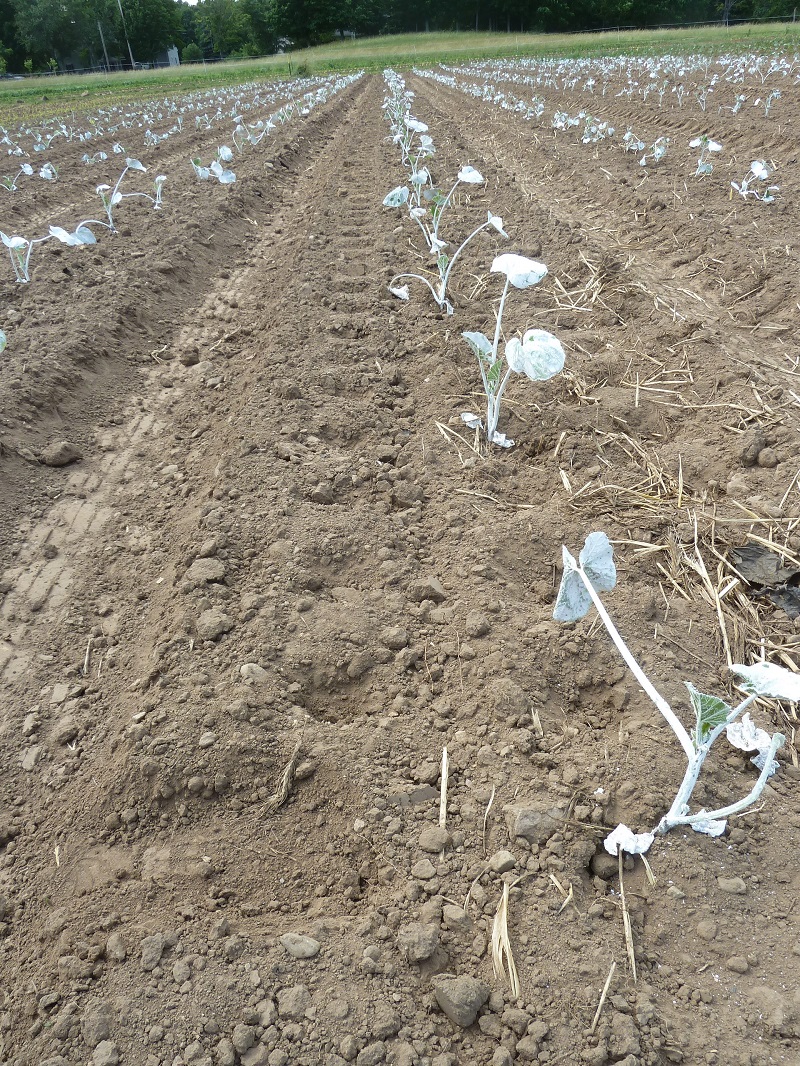 Foliar insecticides: There are a number of broad-spectrum conventional insecticides which can be used for foliar control of adult beetles, including carbamates (e.g. Lannate), pyrethroids (e.g. Warrior II, neonicotinoids, and diamides (e.g. Harvanta). All are highly toxic to bees and should only be used before bloom. Avoid using foliar neonicotinoid sprays if the same class was used as a seed or soil treatment (see below). See the cucurbit insect management section of the New England Vegetable Management Guide for more details.
Systemic insecticides including neonicitinoids and diamides can be applied to seed (e.g. thiamethoxam or ‘Farmore’ treated seed) or as an in-furrow, banded, drench, or drip irrigation application to the seed/seedling root zone during or after planting/transplanting operations e.g. Verimark (IRAC group 28). These offer about 21 days of protection right at the critical establishment period and before flowering. Note specific application methods and rates on labels. Take care to reduce risk to pollinators when using systemic insecticides - see the section below for details.
Organic insecticides: Kaolin clay (Surround WP), pyrethrin (Pyganic Crop Spray 5.0 EC), and Azaguard (azadirachtin) are labeled for SCB. Surround does not kill the beetles but instead acts as a physical deterrent. With direct-seeded crops, apply Surround as soon as seedlings emerge if beetles are active. Transplants can be sprayed or dunked before setting out in the field—consult with your organic certifier about dunking beforehand to ensure they will allow this use pattern. As with other non-systemic insecticides, Surround must be re-applied after heavy rain and on new growth. Pyganic is a contact insecticide that provides a short-term knock-down of adult beetles with no residual effect. Spinosad (Entrust) is not labeled for and is not effective against SCB.
Reducing risk to pollinators: The New England Vegetable Management Guide describes many steps that growers can take to protect honey bees and native pollinators when using insecticides. The issue of neonicotinoids in particular has received a great deal of attention in recent years. This is a group of insecticides that have a chemical structure very similar to nicotine. They have been widely used in agriculture because they are effective against a wide range of insects, have lower mammalian toxicity compared to older classes of insecticides, and because they can be absorbed by roots and moved through the entire plant, reducing the need for foliar sprays. This trait allows for applications to be made to soil or on seeds, with less exposure to humans and to natural enemies of insect pests. Neonicotinoids are highly toxic to bees, and label requirements prohibit use on blooming crops or where there are blooming weeds or borders. Additional concern about impact on bees arises because research has shown that detectable, low concentrations of neonicotinoids can move into pollen or nectar. These are present at sublethal concentrations but may affect the foraging behavior of bees or suppress their immune system. The long-term or colony effects of sublethal concentrations of neonicotinoids are difficult to assess in the field because bees from each colony travel long distances and forage in many different habitats and types of plants. In cucurbits, both native bees (e.g., squash bees and bumble bees) and honey bees visit flowers to gather both pollen and nectar and are essential to crop pollination. Research in cucurbits has shown that higher levels of neonicotinoids were found after foliar treatments and chemigated insecticides were applied during flowering. Lower levels were detected in treatment regimens that involved a single application at planting via seed treatment, a drench application to transplant trays, or transplant water treatment. Thus, growers should avoid high rates and multiple applications, especially as the crop approaches flowering.
--UMass Extension Vegetable Program
Garlic Update
--Written by Crystal Stewart, Cornell University, Eastern New York Horticultural Program

Now is the time when seed-borne insect and disease issues may become apparent in garlic crops. There are several issues that can cause poor stands, stunted plants or yellowed foliage that you might be seeing now or in the next few weeks. These include diseases such as basal rot (Fusarium), white rot (Sclerotinia), and occasionally Botrytis, stem and bloat nematode (Ditylenchus dipsaci), and bulb mites (Aceria tulipae and Rhyzoglypous spp.) plus a suite of viruses that are poorly understood. At this stage, there is not much to do about these pest issues except rogue out affected plants and don’t save seeds from affected fields, but there is still lots you can do to make sure you have the best possible garlic crop. (For more information about growing garlic, check out past articles about culling garlic and garlic harvest, curing and storage)
The focus now is on making sure that the garlic plant that you have already grown is able to put all of its available energy into a strong, healthy bulb. Controlling weeds, maintaining adequate field moisture, and scaping will all help to maximize yield. Continued field culling will maximize quality, an especially important factor if producing garlic for seed.
Avoid Over-Fertilizing Garlic: Garlic will not respond with improved yield to applications of nitrogen after the summer solstice. These late applications of nitrogen could delay the normal maturity of garlic and may even aggravate some diseases. 2022 editor’s addition: Research in 2017 and 2018 from Cornell Cooperative Extension showed that 50 lbs of N per acre in the spring, when garlic begins to grow, is sufficient to maximize yield. The same studies showed that garlic has taken up all of the N it will need by the end of May, and that seed clove size was actually more important than N availability for maximizing bulb sizes and yields.
Weed control: Continue to control weeds in the garlic planting for at least the next few weeks. Weeds will compete for moisture and will make it more difficult to harvest garlic. Most growers will want to complete at least one more cultivation pass on bare ground, and may need to hand-weed mulched beds.
Maintain Field Moisture: Garlic needs adequate moisture as it forms the bulb to maximize size. If you can, supply one inch of water per week to the garlic if no rain is forecast. Plasticulture growers and those with heavy straw mulch should keep checking moisture levels under the mulch, though they may need to water less than bare ground growers. Keep watering until a couple weeks before harvest, as needed.
Scaping: Removing the scape may provide up to a 30% yield boost, depending on soil conditions and weed competition. If you can sell the scape to recoup the cost of labor used to remove it, even better! If you can’t sell them, snap them and leave them in the field to speed up the process.
Field Culling: Continue to walk the garlic field and pull plants which are unusually wilted on warm, dry days (plants that are distorted or curled or off color, typically yellow or bright green) and discard them. All of these plants will either have a physical defect such as feeding injury or may have a disease such as Fusarium or mites. This is a particularly important step if you plan to save your garlic for seed or to sell it as seed. Even sickly garlic will often still make a small bulb. Once it is cured, a small bulb with disease issues can look remarkably like a healthy small bulb, though the pathogen is still present. Field culling is your best quality control option.
News
MDAR Climate Smart for Agriculture Program (CSAP)
MDAR is now accepting applications from agricultural operations interested in participating in the Climate Smart for Agriculture Program (CSAP), a combination of previous funding programs including the Agricultural Climate Resiliency & Efficiencies Grant (ACRE), the Agricultural Environmental Enhancement Program Grant (AEEP) , the Ag-Energy Program Grant (ENER), the Agricultural Food Safety Improvement Program (AFSIP), and the Agricultural Composting Improvement Program (ACIP). By consolidating these programs, MDAR aims to simplify access and enable more agricultural operations to pursue impactful improvements in food safety, climate resiliency, energy efficiency, environmental sustainability, and composting practices.
The CSAP grant supports farmers in adapting to changing climate conditions through practices that:
- Improve soil health
- Ensure the efficient use and availability of water
- Prevent impacts on water quality
- Reduce energy use and reliance on fossil fuels
- Strengthen on-farm food safety
- Encourage composting and nutrient recycling
- Promote innovative technologies that improve overall resource efficiency
Interested operations are encouraged to review the Request for Response (RFR) on the program’s website for complete program details. Applicants may submit questions regarding the RFR and application process by email to MDARGrants[at]mass[dot]gov (MDARGrants[at]mass[dot]gov). The deadline to submit questions is 4:00pm on Thursday, May 29, 2025. Answers to all submitted questions will be posted on the CSAP webpage.
Application deadline: Wednesday, June 18, 2025 at 4:00 PM
USDA Emergency Commodity Assistance Program (ECAP)
ECAP is a one-time payment program administered by the USDA’s Farm Service Agency (FSA). It targets producers of eligible commodities who faced significant financial challenges in 2024 due to market uncertainties and increased production costs. The program offers per-acre payments based on planted and prevented planted acres, ensuring farmers receive support proportional to their operational scale. Payments cover 100% of planted acres—used for harvest, grazing, haying, silage, or similar purposes—and 50% of acres prevented from planting due to circumstances beyond producers’ control.
To be eligible, producers must meet the following requirements:
- Be actively engaged in farming.
- Have an interest in input expenses for a covered commodity.
- Have reported acreage of eligible commodities to FSA for the 2024 crop year planted and prevent plant acres to FSA on and FSA-578, Report of Acreage form.
- Have reported acres that were prevented from being planted to FSA for the 2024 crop year on an CCC-576 Notice of Loss form (if applicable).
Click here for more information on eligibility, payment rates, and how to apply.
Application deadline: August 15, 2025
Events
Twilight Meeting at Small Farm - Irrigation and Climate Adaptation
When: Tuesday, June 24, 2025 from 4:00 pm to 6:00 pm
Where: Small Farm. 184 Gleasondale Rd., Stow, MA 01775
Registration: Event is free, please register in advance. Register here.
Last year the team at Small Farm tried out a simple, relatively low-cost tool for monitoring soil moisture—Watermark sensors. Hear about their experience using the sensors, what they observed, and how the sensors have impacted irrigation practices in both the high tunnel and the field. UMass Extension staff will discuss other ways to optimize production, manage weeds, and mitigate the effects of climate change in sensitive crops like tomatoes, lettuce, and roots in the tunnel and field.
Questions? Contact Sue Scheufele, sscheufele[at]umass[dot]edu (sscheufele[at]umass[dot]edu)
Hudson Valley Orchard Weed Management Workshop
When: Wednesday June 25th, 2025, 1-3 pm
Where: Titusville Farm, 84 Titusville Rd, Poughkeepsie, NY
Registration: Free but please register here.
This event is presented by Cornell Cooperative Extension but may be of interest to Massachusetts growers! It will cover research on using mulch for weed management, including the benefits of stacking mulch treatments with an organic herbicide program. They will then walk through the treatments in an ARDP-funded field trial, discuss results to-date, and get initial reactions from growers. They will then go into another study objective, using a mechanical weeding system (Rinieri) to replace contact herbicide applications currently underway in the Champlain Valley.
Questions? contact Mike Basedow, mrb254[at]cornell[dot]edu (mrb254[at]cornell[dot]edu) or 518-410-6823
Twilight Meeting at Night Owl Farm - Building a Diversified Farm Business in the first five years + Pest Walk
When: Thursday, June 26, 2025 from 5:00 pm to 7:00 pm
Where: Night Owl Farm. 49 Prospect St, Franklin, MA 02038
This Twilight workshop will focus on building a sustainable farm business, particularly in the critical first years, and diversifying market channels to maximize success. Night Owl Farm leans into Ali Oakley's background as a former teacher and runs a summer program for kids, a wide range of public workshops, a seedling sale, CSA, and online store.
We will also be joined by Susan Scheufele, a vegetable production specialist from UMass Extension, who will lead us in some pest identification and discussion of pest life cycles, one of the keys to managing pests without pesticides.
This twilight meeting is hosted by SEMAP. Event is free, please register here.
Questions? Contact Sue Scheufele, sscheufele[at]umass[dot]edu (sscheufele[at]umass[dot]edu)
Twilight Meeting at Clark Farm - Cut Flowers
When: Wednesday July 2nd, 2025, 4-6 pm
Where: Clark Farm, 185 Concord St, Carlisle, MA 01741
Registration: Free
Clark Farm is a small "Real Organic Project" certified diversified farm. 75% of farm revenue comes from CSA membership. Increasingly, cut flowers have become more important to the farm. Flower CSA shares, bouquets, PYO flowers, and flower workshops are a growing revenue source. Come learn how Assistant Manager Mary Liz manages all aspects of the cut flower operation.
Twilight meeting hosted by EMass CRAFT. Event is free, no registration required.
Twilight Meeting at Appleton Farms - Pest and Disease Management
When: Wednesday, July 16, 2025 from 4:00 pm to 6:00 pm
Where: Appleton Farms, 219 County Road, Ipswich, MA 01938
Join us at Appleton Farms to learn more about pest management. Sue Scheufele of UMass Extension will talk about some of the most prolific and problematic pests and diseases in organic farming systems, including tips on scouting and pest identification. Learn to see the farm with fresh eyes!
Twilight meeting hosted by EMass CRAFT. Event is free, no registration required.
Questions? Contact Sue Scheufele, sscheufele[at]umass[dot]edu (sscheufele[at]umass[dot]edu)
Twilight Meeting at Four Town Farm - Irrigation and Pest Management in Sweet Corn
When: Thursday, July 31, 2025 from 4:00 pm to 6:00 pm
Where: Four Town Farm, 90 George St., Seekonk, MA 02771
Registration: Event is free, please register in advance. Register here.
Chris Clegg grows 45 acres of sweet corn for sale at his farmstand and wholesale accounts. UMass Extension staff will discuss pest management in sweet corn focusing on weeds and insects, and Chris will explain how they have learned to control their biggest pest—BIRDS! Chris and his crew use netting on all 45 acres of sweet corn to keep out birds as well as corn earworm, come see how it works. We will also hear about the multiple water sources and irrigation tools Chris utilizes to keep crops watered across the many disparate fields that make up the farm, and how to manage food safety risk associated with different water sources.
This twilight meeting is hosted by SEMAP.
Questions? Contact Sue Scheufele, sscheufele[at]umass[dot]edu (sscheufele[at]umass[dot]edu)
Twilight Meeting at Reed Farm – Compost Production and Use
When: Wednesday, August 13, 2025, from 4 to 6 pm, followed by refreshments
Where: Reed Farm, 136 Russell Street, Sunderland, MA 01375
Registration: coming soon!
This program is for farmers who use compost, make compost or want to make compost! Reed Farm is a pasture-raised poultry farm that produces compost using materials generated on the farm. We’ll cover considerations for successful composting, using compost as a soil amendment, weed management and composting, and the MDAR Agricultural Composting Program and Composting Improvement Grant.
Questions? Contact Lisa McKeag, lmckeag[at]umass[dot]edu (lmckeag[at]umass[dot]edu) or 413-658-8631
Vegetable Notes. Maria Gannett, Genevieve Higgins, Lisa McKeag, Susan Scheufele, Alireza Shokoohi, and Hannah Whitehead, co-editors. All photos in this publication are credited to the UMass Extension Vegetable Program unless otherwise noted.
Where trade names or commercial products are used, no company or product endorsement is implied or intended. Always read the label before using any pesticide. The label is the legal document for product use. Disregard any information in this newsletter if it is in conflict with the label.
The University of Massachusetts Extension is an equal opportunity provider and employer, United States Department of Agriculture cooperating. Contact your local Extension office for information on disability accommodations. Contact the State Center Directors Office if you have concerns related to discrimination, 413-545-4800.